
Build the reports you need
— and the skill to build the next one.
ECS coaches your finance team to build and own their financial reporting in Infor CloudSuite Financials. You keep the capability. We keep you supported.
20+ years of Infor financial reporting. Certified Project Management.


The Problem
Every report request becomes a ticket. Month-end stretches because the numbers live in spreadsheets. Department heads wait on finance to tell them where they stand. And when you finally get a report built, the knowledge walks out the door with whoever built it.
The usual fix solves today's report and leaves you dependent for the next one — so the cycle repeats.
The Solution
We don't just build your reports. We empower your team to build them.
That's the difference. A traditional partner delivers a report and leaves. ECS coaches your reporting champion to build it themselves — and stays alongside your team with the full weight of our expertise behind them.
Your Reporting Journey
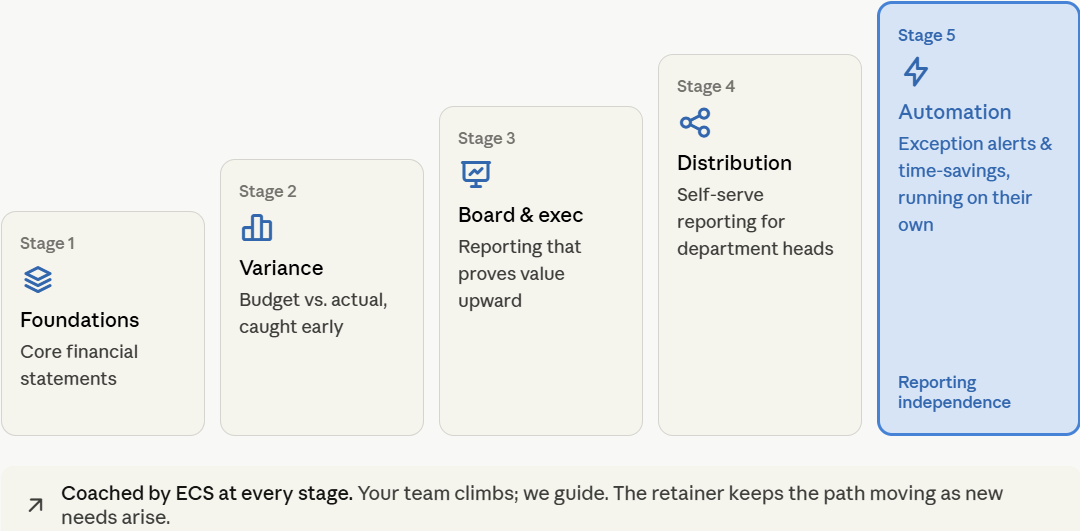
From foundations to automation — coached by ECS, owned by you
Every team starts somewhere. We meet you at your foundation and coach your champion up the path — each stage builds on the last, and your team owns every step.
You own it
Your team learns to build financial reports in Infor, coached against a proven reference design and documented so the knowledge stays with you, not us.
You see it early
With reporting you control, you catch budget variances and issues before close — not after the books are shut.
You're fully supported
You're never on your own. Behind your champion stands a team with deep Infor expertise, proven best practices, and project-management discipline — guiding, reviewing, and advocating for you every step.
The ongoing partnership
Every month, your reporting gets stronger — and so does your team.
Reporting needs never stop — new board requests, new departments, new regulations, staff who move on. The ECS retainer keeps your roadmap moving and your team supported, with a defined set of deliverables every month.
Here's what that looks like:
Knowledge transfer, built in
Only ECS does this
Our whole model is teaching. Your team grows more capable with every engagement — not more dependent.
A documented solution, always
Only ECS does this
Every report we coach comes with design documentation — your team keeps the skill and the blueprint.
Your advocate
Only ECS does this
We bring project-management discipline to your Infor roadmap — keeping your reporting priorities moving, on schedule, and aligned to what matters most.
Start Here
The Reporting Quick Start
A fixed-scope engagement that makes your reporting champion able to build your core financial statements — income statement, balance sheet, and trial balance — in Infor CloudSuite Financials. Coached step by step against a proven reference design. At the end, your team has both a working report set and the skill to extend it.
- Built with your team's own hands, coached by ECS
- Fixed scope, fixed price — no open-ended consulting
- Your champion finishes capable, not dependent
- Rolls naturally into ongoing reporting support
When you're ready to go deeper: month-end close
Slow reporting is often the first sign of a close that takes too long. Once your reporting foundation is in place, the same coaching model applies to your close — catching issues early, fixing root causes, and making the improvements stick. Reporting gets you in control; close is where it compounds.

ECS Reporting Solutions is a specialized Infor CloudSuite Financials reporting practice with roots going back to Lawson. We focus on healthcare finance, and we've spent 20+ years doing one thing exceptionally well: making financial reporting work in Infor. As an Infor Preferred Delivery Partner, we bring that depth — backed by proven methodology, design documentation, and project-management discipline — to your team, and we leave it there.
Start with a clear picture of where your reporting stands
Take the free reporting roadmap diagnostic. In a few minutes, you'll have a prioritized view of what to build next — and a clear first step.